Electronics storefront, Nepal
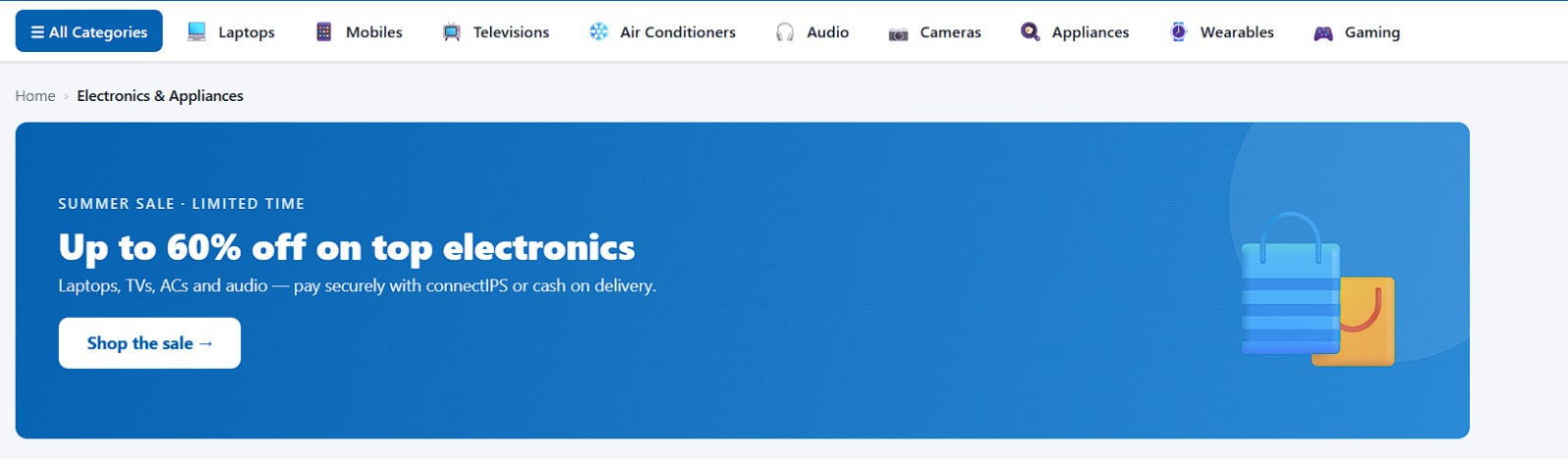
A commerce platform built for one market rather than adapted to it: Nepali rupees, connectIPS as the primary rail, cash on delivery as the realistic fallback, and search that still finds the right product when a name is mistyped or abbreviated.
Scope
Scoped to one market on purpose: Nepal, Nepali rupees only. Payments, tax handling, and how the online catalog stays in sync with the offline store all follow from that single decision. Narrowing the scope this way means less surface area to build, test and maintain, and a checkout tuned to how people here actually pay (connectIPS and cash on delivery) rather than a card-first flow a multi-region platform would default to.
Decisions worth naming
connectIPS as the gateway, COD as the honest secondary. Card penetration doesn’t justify building card-first here.
Search on Postgres rather than a search service. Full-text plus pg_trgm for trigram similarity, indexed across name, brand, SKU, specs and description. It tolerates typos, and it means no second system to keep in sync.
Supabase Pro over the free tier. The free tier auto-pauses on inactivity and has no backups. Neither is acceptable when someone’s revenue runs through it.
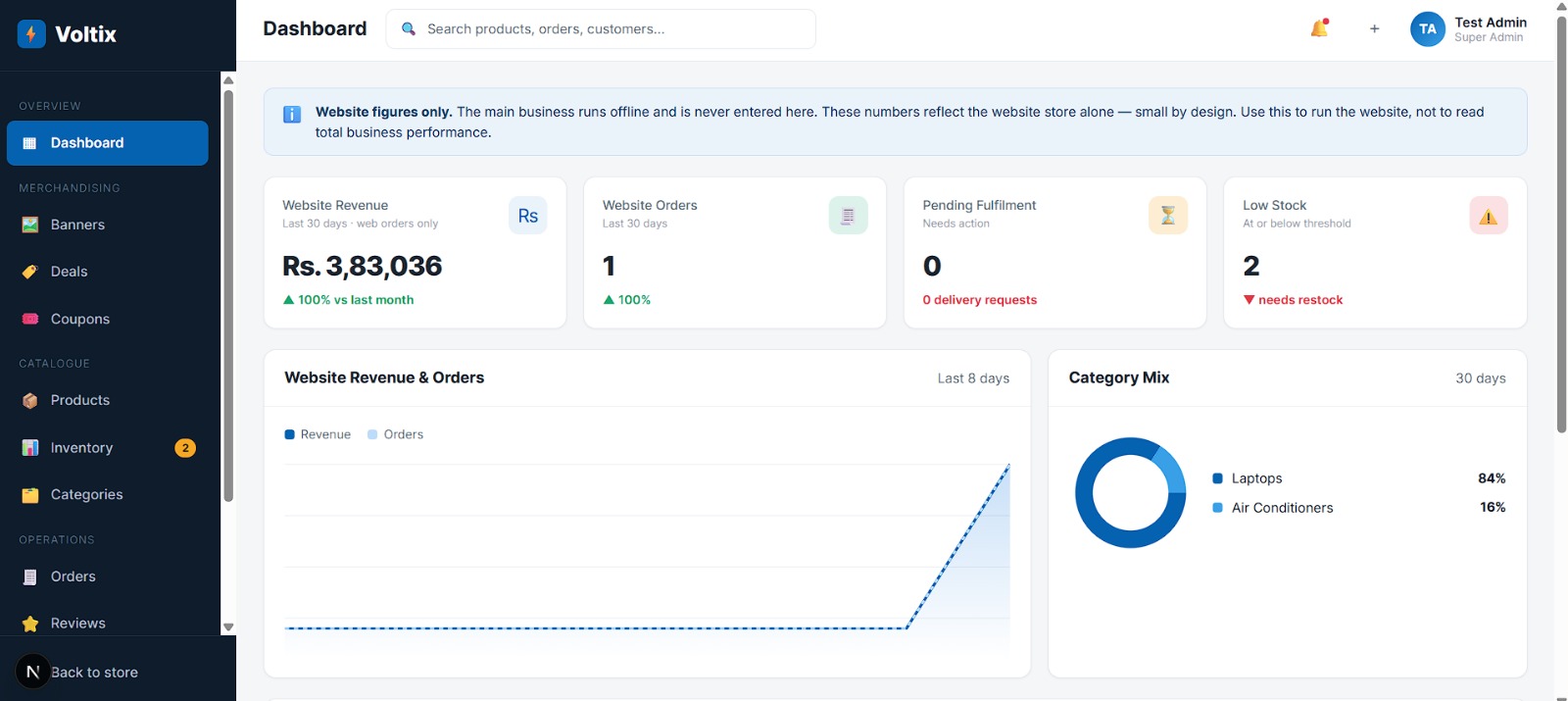
The admin panel manages the website, not the business. It leads with merchandising (banners, deals, coupons), then catalogue, then operations. Deliberately not an ERP. The offline logistics stay offline; checkout feeds them with a tick box rather than pretending to automate shipping.
What’s built
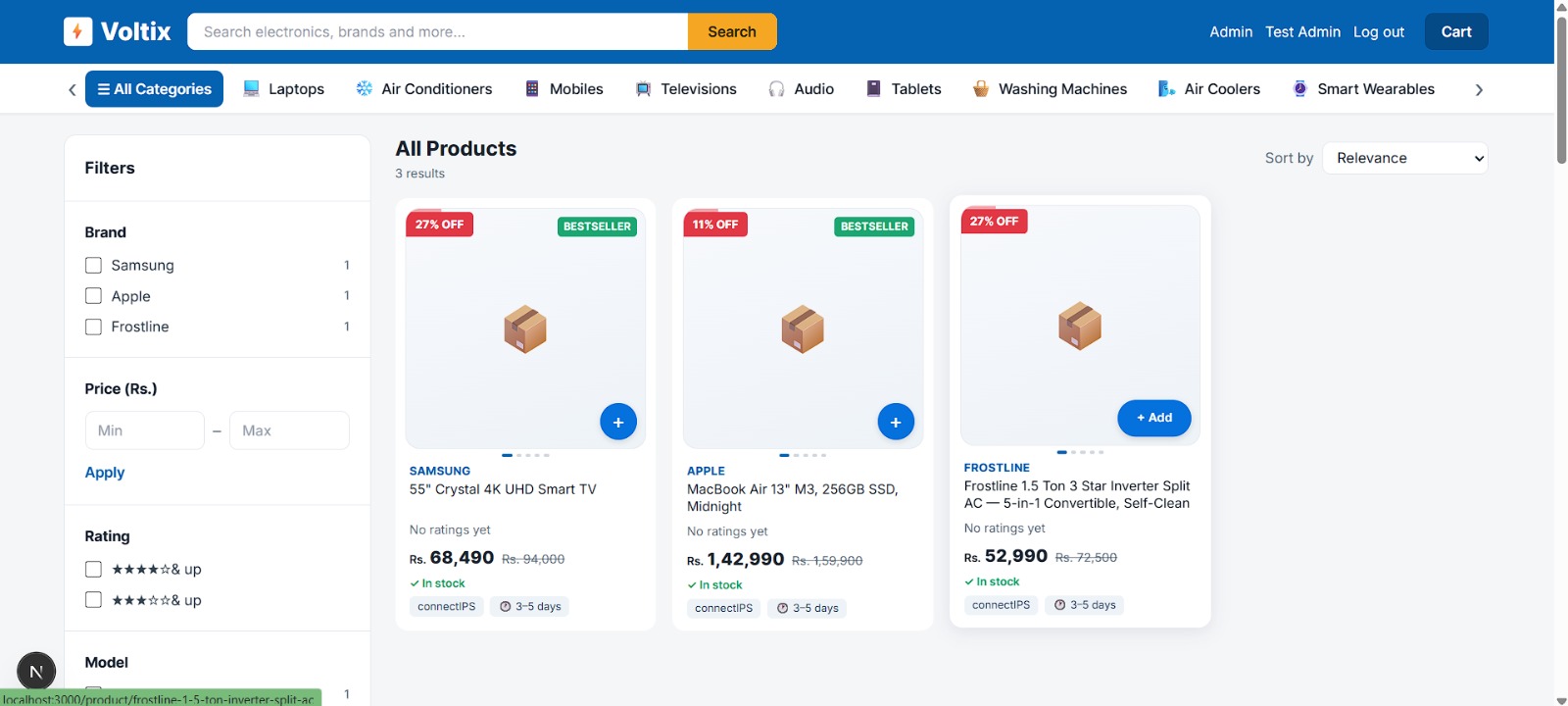
Storefront. A homepage built around an editable banner carousel and product rails, category listing with a faceted filter sidebar (brand, price, spec attributes) and sorting, and the search described above with autocomplete on top of it.
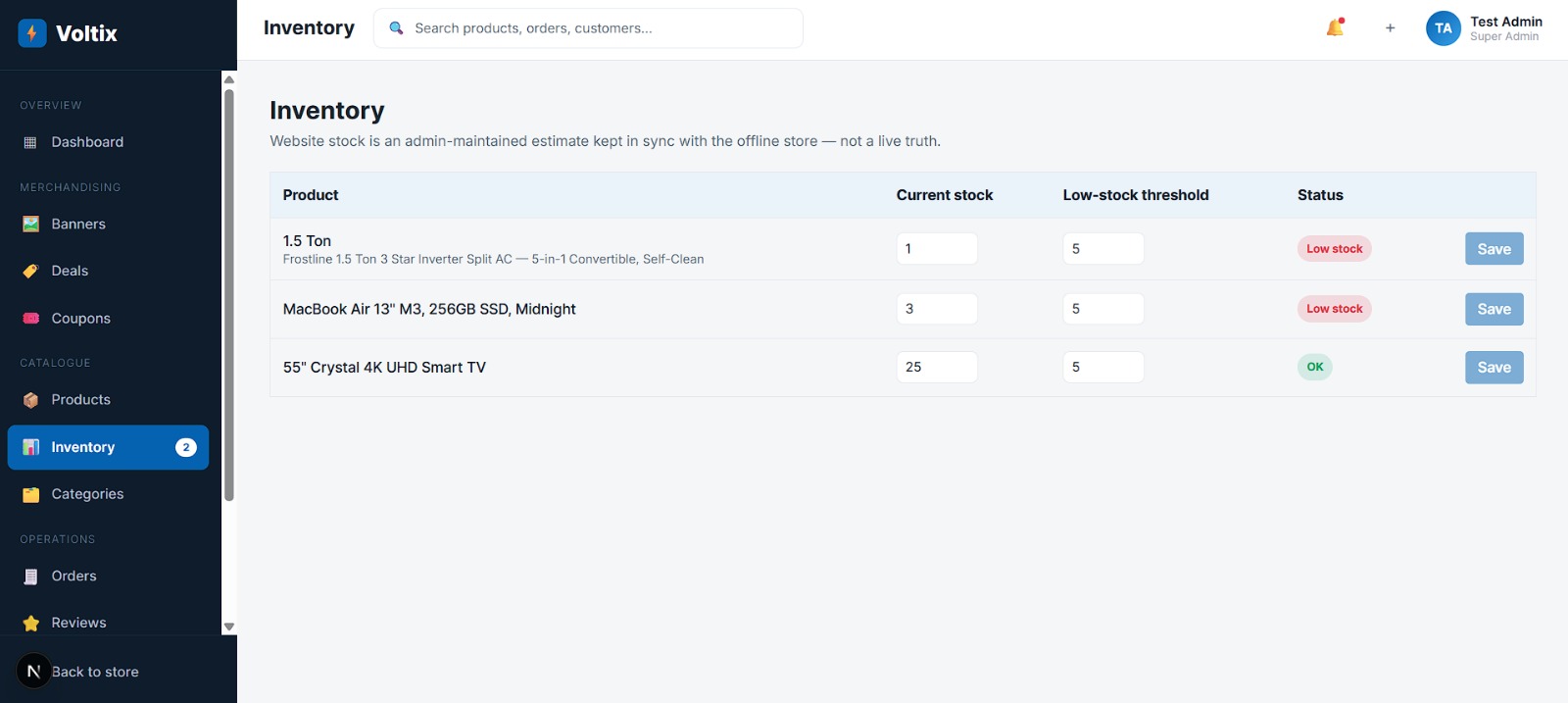
Catalog and merchandising. Full CRUD on products, with variants edited inline in the same table rather than a separate screen, and a duplicate action for listing the next model in a range without re-typing shared specs. Categories, brands and specification attributes are each independently manageable. Inventory adjusts inline (type a number, tab out, done) with a low-stock count computed across products and variants, not just top-level SKUs. Banners, deals and coupons are edited from the same panel, alongside bulk visibility and Featured/Bestseller toggles for the repetitive catalogue chores.
Operations. Order filtering, bulk status and fulfillment updates, printable invoices, and unpaid-order tracking. Delivery is deliberately lightweight: address, contact, and free-text instructions, nothing that pretends to automate logistics the business runs offline. Customers can be listed, blocked or suspended; reviews go through moderation before they’re public. Every mutation is validated server-side with Zod regardless of what the client sent.
Permissions and audit. Access is permission-keyed rather than a single isAdmin flag: every admin page checks can(user, key) against a User → Role → RolePermission → Permission chain, so a second staff role later doesn’t mean rewriting checks by hand. Every admin mutation writes an AdminAuditLog row (actor, action, entity, timestamp), so “who changed this price” has an answer.
Store configuration. Tax is a toggle, not a redeploy: tax_enabled and tax_rate live in a Setting table, and switching it off removes VAT from the storefront immediately. Store name, contact details and logo are editable the same way.
Status
Core infrastructure is complete and the app is production-deployable, minus the connectIPS payment flow. That piece was sequenced last, waiting on UAT credentials from NCHL, and the Payment model exists in the schema without live transactions flowing through it yet. The repo ships with seed data (npm run db:seed) so the whole thing runs and is reviewable before that last piece lands.
A lesson learned building this
Prisma treats schema.prisma as the single source of truth and will drop database objects it doesn’t know about, unlike Alembic, which leaves unknown objects alone. The trigram and full-text indexes are exactly the kind of object it doesn’t know about.
The working practice: always prisma migrate dev --create-only, read the generated SQL, and strip the spurious DROP INDEX lines before applying. Separately, migrate dev hangs against Supabase because internal services block shadow-database drops; a dedicated prisma_shadow database via SHADOW_DATABASE_URL resolves it.